From Fresher to Experienced Developer: 7 Years of Lessons I Wish I Knew Earlier
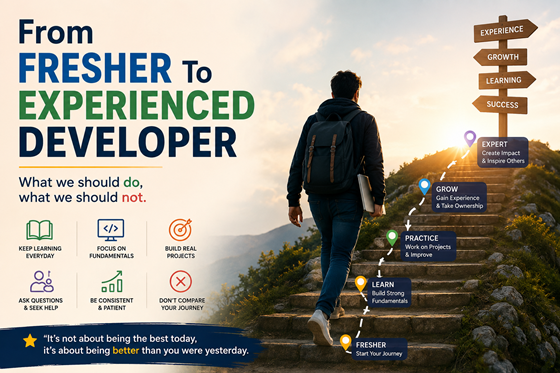
By Rohit Durgapal
Senior Software Engineer | Frontend Developer | React.js | Next.js | TypeScript
Starting a career in software development can be exciting, confusing, and sometimes overwhelming.
When I started my career, I thought becoming a good developer was mainly about learning programming languages, frameworks, and writing good code.
After several years in the industry, I have realized that software development is much more than coding.
It is about solving problems, understanding requirements, communicating with people, learning from mistakes, taking ownership, and continuously improving yourself.
I started my professional journey as a trainee developer. Today, I work as a Senior Software Engineer, primarily focusing on frontend development with technologies such as React.js, Next.js, TypeScript, and JavaScript.
Looking back, there are many things I wish I had understood earlier.
Here are some of the most important lessons from my journey.
1. Don't Try to Learn Everything at Once
When you are a fresher, you will see developers talking about React, Angular, Vue, Node.js, Next.js, AWS, Docker, Kubernetes, AI, and many other technologies.
It is easy to think:
"I need to learn all of these to become a good developer."
You don't.
Focus on building strong fundamentals first.
For a frontend developer, understanding JavaScript, HTML, CSS, browser fundamentals, APIs, Git, debugging, and testing is extremely valuable.
Once your fundamentals are strong, learning new frameworks becomes much easier.
Don't chase every new technology. Build a strong foundation first.
2. Don't Be Afraid to Ask Questions
One thing many freshers struggle with is asking questions.
I also used to think:
"If I ask this question, people might think I don't know enough."
But asking questions is a normal part of learning.
There is, however, a difference between asking a question without trying and asking after making an effort.
Instead of saying:
"This is not working. What should I do?"
Try explaining:
"I tried these approaches, checked these areas, but I'm getting this error. I think the issue might be here. Can you help me understand it?"
This shows that you are trying to solve the problem yourself.
Ask questions, but first make an honest attempt to find the answer.
3. Understand the Requirement Before Writing Code
As a beginner, it is easy to jump directly into coding.
But experienced developers learn to pause and understand the problem first.
Before implementing a feature, ask yourself:
- What problem are we solving?
- Who will use this feature?
- What should happen when something goes wrong?
- What are the edge cases?
- What happens with empty or invalid data?
- What should the user see in different scenarios?
4. Learn Git Properly
Initially, Git might seem simple:
git pull git add git commit git push
But as you work on larger projects and teams, Git becomes much more important.
Understanding things like branching, pull requests, merge conflicts, rebase, cherry-pick, revert, amend, and code reviews can make your development workflow much easier.
5. Don't Ignore Testing
Testing can sometimes feel like an additional task when you're starting your career.
But over time, you realize that testing is an important part of software development.
For frontend development, learning tools such as Jest and React Testing Library can help you understand how to test components, interactions, API calls, error scenarios, and edge cases.
6. Code Review Is an Opportunity to Learn
Code reviews can be uncomfortable when you're new. Someone may suggest changing your implementation, improving naming, restructuring your code, or handling an edge case differently. It's easy to take that personally. Don't. A code review isn't necessarily saying "Your code is bad." It can simply mean "There might be another way to solve this problem." Learn to separate yourself from your code.
7. Bugs Are Part of Development
Every developer writes code that eventually has a bug. The important thing isn't whether you make mistakes. The important thing is how you respond to them. When something breaks, instead of only asking "How do I fix this?" also ask "Why did this happen?"
8. Don't Chase Every Trending Technology
Technology changes extremely quickly. A technology that is popular today may not be as popular a few years from now. That doesn't mean you should ignore new technologies. It means you shouldn't build your career around a particular technology name. Build your career around: Problem solving + fundamentals + adaptability.
9. Communication Is Also a Developer Skill
Technical knowledge is important. But communication becomes increasingly important as your experience grows. You need to be able to explain what you built, why you built it, what problem you faced, what solution you implemented, what trade-offs you considered, and what support you need.
10. Take Ownership
One of the biggest differences between simply completing a task and growing as a developer is ownership. Don't think only "I completed my ticket." Think "Is the problem actually solved?"
11. Build Projects Outside Your Job
Your professional work gives you valuable experience. But personal projects give you something different: freedom to experiment.
12. Don't Compare Your Career With Others
This is probably one of the most important lessons. Someone may get promoted before you. Someone may switch jobs and get a higher salary. Someone may learn a technology faster. Someone may have a completely different career path. That's okay.
What I Would Tell My Fresher Self
If I could go back to my first day as a developer, I wouldn't tell myself "Learn every new technology." I would tell myself: Learn the fundamentals. Ask questions. Understand the requirement. Don't be afraid of making mistakes. Learn from code reviews. Write tests. Improve your communication. Take ownership. Keep learning. And most importantly: Be patient with your career.
Final Thoughts
Going from a fresher to an experienced developer isn't a straight line. There will be times when you feel confident and times when you feel like you don't know enough. That's normal. Technology will change. Projects will change. Companies will change. Your responsibilities will change. But if you keep improving your fundamentals, problem-solving ability, communication, and willingness to learn, you will continue to grow.
Rohit Durgapal is a Senior Software Engineer and Frontend Developer with experience in building modern web applications using React.js, Next.js, TypeScript, and JavaScript.